
How to Choose a Travel Trailer Manufacturer for Your Market
The right travel trailer manufacturer is not simply the one that can build a sample. It is the partner whose engineering process, production controls, communication and shipment readiness match the market you plan to serve.
Evaluate a manufacturer by checking whether it can translate your buyer profile into a repeatable specification, demonstrate process control at critical build stages, support the evidence your market requires, and communicate clearly before production and before shipment.
Start with the use case, not the brochure
A product brief becomes useful when it describes the end customer in practical terms: towing environment, expected occupancy, climate, average trip length, retail position and service expectations. A compact weekend trailer for a coastal rental fleet will ask different questions from a twin-axle touring caravan for a distributor network.
Before requesting a quote, define the non-negotiables. These usually include dimensions, target unladen and gross mass, axle and suspension requirements, power system, insulation approach, sleeping layout, exterior finish, service access and any market-specific interfaces. The goal is not to freeze every detail early; it is to give engineering a stable starting point.
For a useful handover, ask the factory to summarize open decisions in a version-controlled product specification. This helps prevent a sample from drifting away from the production intent.
What to inspect at a travel trailer factory
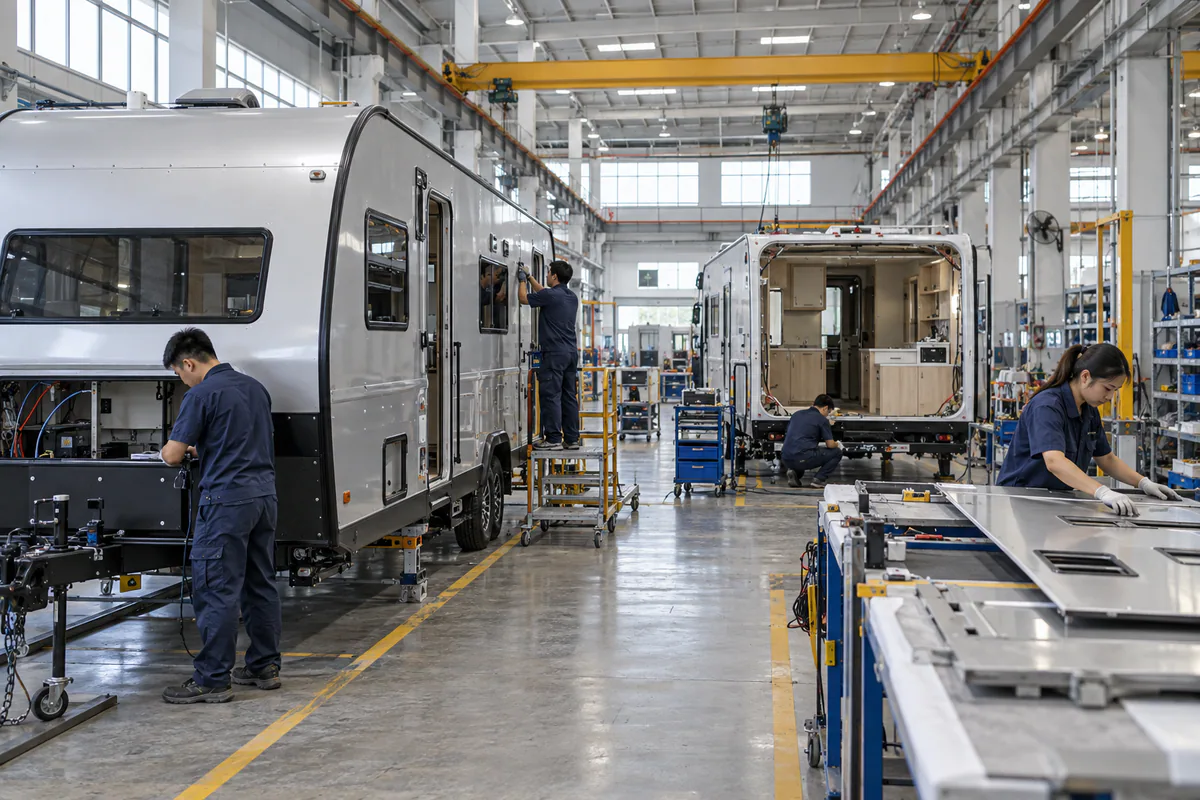
The most revealing factory review is a walk through the production flow. Look for how components move from incoming checks through chassis assembly, body build, electrical integration, finish work, final inspection and shipment preparation. A polished showroom trailer alone cannot show whether those steps are repeatable.
- Chassis and running gear: Ask how jigs, weld quality, corrosion protection and key attachment points are controlled.
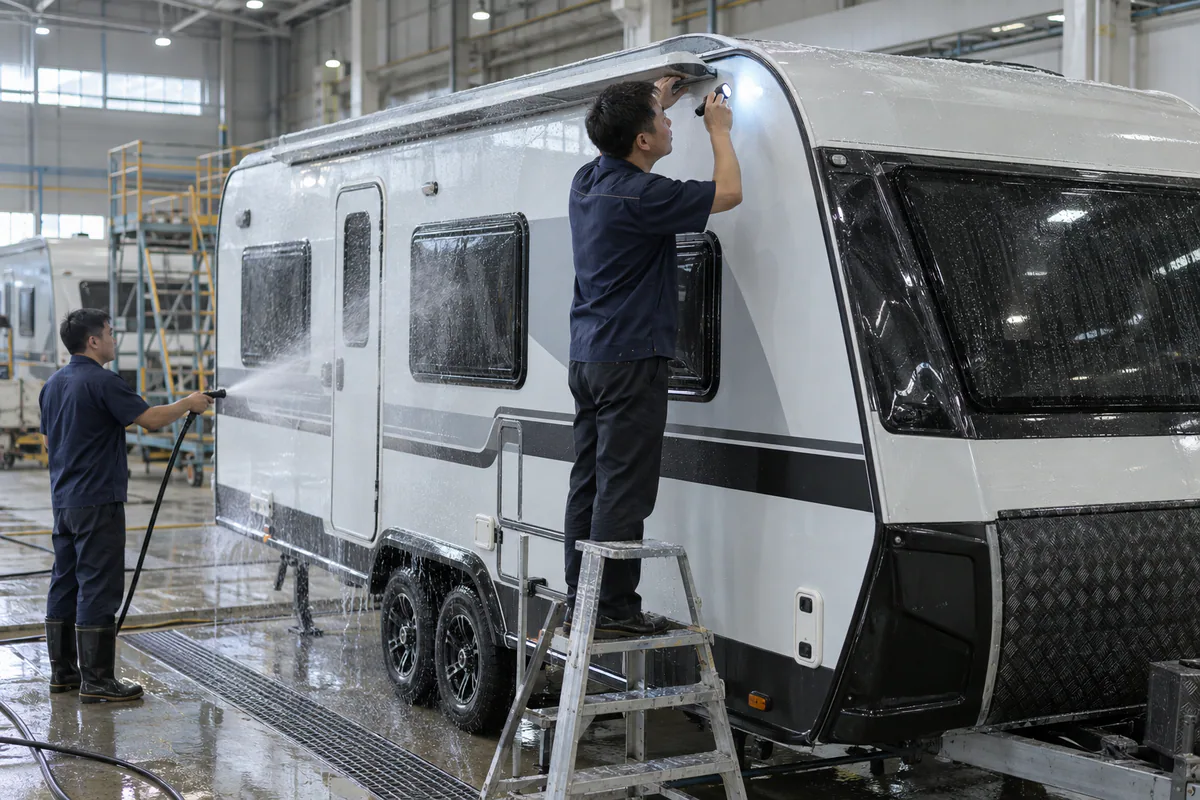
- Water and sealing work: Clarify where roof seams, doors, windows and service penetrations are checked before handover.
- Electrical integration: Review cable routing, labelling, protection and access for routine service.
- Final inspection: Request a project-specific checklist rather than a generic assurance statement.
At RVDwell, our Shenzhen production campus covers 8,000 m² and brings fabrication, fit-out, testing and shipment preparation into one workflow. You can explore the production environment on our factory capability page.
Compare suppliers using evidence, not promises
Supplier comparisons work best when every candidate answers the same operational questions. This makes differences in scope, documentation and delivery readiness easier to see before a deposit is paid.
| Evaluation area | What to ask for | Why it matters |
|---|---|---|
| Product brief | Revision-controlled specification and open-item list | Protects the production intent as details evolve. |
| Sample review | Photo record, change list and approval points | Turns feedback into traceable decisions. |
| Quality process | Build-stage checks and final inspection record | Shows how the factory verifies the agreed build. |
| Shipment readiness | Packing plan, loading photos and handover file | Helps your team receive the product with context. |
Quality-management systems are not a substitute for product-level inspection, but they provide useful context. ISO 9001 describes requirements for a quality management system, while the UNECE vehicle-regulation resources help buyers understand the broader regulatory environment. Confirm the exact rules and evidence required for your destination market with qualified local specialists.
Plan customization around production reality
Private-label projects become more manageable when customization is organized by impact. Start with the structural and market-critical items: chassis, overall dimensions, layout, systems, insulation and required interfaces. Then address visible differentiation such as exterior trim, interior finishes, graphics and accessory packs.
This sequence makes it easier to protect delivery timing. It also gives your commercial team a clear record of what is standard, what is optional and what requires engineering confirmation. Our custom build page outlines the typical brief-to-delivery path.
Questions to resolve before production starts
Before production release, both teams should agree on the approved specification, sample sign-off method, in-process update cadence, final inspection scope, documentation required at shipment and the escalation route for changes. These are practical project controls, not paperwork for its own sake.
Buyers should also plan installation preparation and after-sales service early. Confirm what information dealers, rental staff or technicians will need at delivery, especially when the configuration includes non-standard equipment.
Assess capacity by observing the production flow
Capacity is more useful as an operating question than as a headline number. A buyer should ask what production is currently running, how the factory schedules similar units, where bottlenecks occur and how it separates prototype work from repeat orders. A large facility does not automatically guarantee a stable build; the evidence is whether materials, work instructions, people and inspection points move through a defined sequence.
During a visit or remote review, follow one unit through the process. Ask where incoming materials are checked, when chassis and body interfaces are verified, how electrical and plumbing work is inspected before panels are closed, and what happens when a nonconformance is found. The answers should describe a process, not only a finished product.
For an initial project, request a realistic production plan with the key decisions that must be complete before each stage. This helps your purchasing team understand when late changes will become disruptive. It also shows whether the manufacturer has considered the work needed for drawings, materials, factory testing and shipment preparation.
Check how engineering questions are closed
Every buyer will have open questions at the quotation stage. The important distinction is between an open question that is visible and controlled and an open question that is silently assumed. Ask the factory how it records technical clarifications, how it identifies an approved revision and who is authorized to release a change to production.
Useful engineering communication is specific. Instead of asking whether a trailer can be “upgraded,” identify the target use case, the component concerned, the expected operating condition and the outcome you need. This gives the manufacturer a basis for a feasibility review. It also makes it easier to compare proposals from different suppliers because each supplier is reacting to the same requirement.
For private-label programs, include the people who will sell and service the product. Dealer feedback, rental handover experience and customer questions are often more valuable than a broad request for premium features. They identify the parts of the product that need to work reliably in the actual market.
Review materials, interfaces and service access
Good workmanship is visible, but many procurement risks sit behind finished panels. A practical review looks at material choices, joint protection, sealing strategy, cable routing, plumbing access, ventilation paths and how routine service items can be reached. You do not need to prescribe the factory's method; you need to understand whether the proposed method fits the product application you are buying.
Ask for component information where it affects service or destination-market use. The goal is not to create an unrealistic technical dossier, but to avoid a configuration in which a routine part cannot be identified or reached once the trailer is delivered. For a rental or dealer program, this is especially important because small service delays can affect customer handover.
Use sample review to check both appearance and access. Open the panels that staff will need to open. Check the route for common cables and hoses. Test doors, windows, latches and storage under normal use. Capture questions in a shared change list so the approved solution is clear before final inspection.
Define the delivery evidence before production begins
Shipment inspection is more useful when the buyer and factory agree the evidence before the trailer is ready to pack. A clear plan can include the approved configuration list, photographs of key installed items, final visual inspection, functional checks that are appropriate to the product and photographs of packing or loading. It should be linked to the requirements in the product brief.
Do not overstate what these records prove. A factory test record can show that an agreed check was completed; it does not replace independent inspection, local type approval, legal advice or the operating checks your business needs after delivery. Being precise about that boundary improves trust and keeps the project evidence useful.
Prepare your receiving inspection at the same time. Confirm who will receive the shipment, what documents they need, how visible transit condition will be recorded and what route will be used if an issue is found. This is a simple way to connect factory work with the first installation preparation in your market.
Use the quotation review to uncover assumptions
A quote is not only a price document. Read it alongside the specification and look for assumptions: which equipment is included, which dimensions or weights are indicative, which finish is assumed, whether installation work is included, what testing is described and what is expected from the buyer before release. Ask for unclear items to be written into the scope rather than relying on a general verbal agreement.
Compare more than the total. A supplier that explains its assumptions, offers a clear option list and identifies open decisions can be easier to work with than one that provides a very short promise. The objective is not to make a supplier look more expensive; it is to understand what is being compared before your team commits to a product program.
Conclusion: choose the manufacturer that can make decisions visible
The right travel trailer manufacturer is a partner that can turn customer requirements into an approved, repeatable product and explain how it will be checked before shipment. Look for practical evidence: a clear brief, realistic feasibility review, defined production checkpoints, service-minded design decisions and an inspection plan connected to the agreed configuration.
Start with your market and the product application, then test each supplier's ability to manage the details that follow. This approach produces a more useful quotation, a more focused sample review and a clearer handover when your trailer reaches the destination market.
A five-step supplier comparison process
First, send each candidate the same concise brief. Second, ask each to identify assumptions, open questions and the evidence it can provide during factory testing and shipment inspection. Third, compare the proposed configuration, not only the price. Fourth, hold a technical review before sample release. Fifth, use a sample and final inspection plan that refers back to the approved brief.
This approach makes supplier selection more evidence-based. It also gives your team a record of why a particular factory, platform or option was chosen. If the project changes later, the original decision path is visible instead of being buried across messages. That is valuable for purchasing, sales, service and quality teams working on the same program.
Frequently asked questions
What should a first RFQ include?
Include target market, expected quantity, preferred dimensions, use case, target price position, timing, key equipment and reference images. If certain specifications are still open, identify them clearly rather than guessing.
Can a manufacturer support an OEM or private-label RV program?
Yes, provided the project brief defines which elements need to change and which production controls are required. Begin with a proven platform, then document market-specific engineering, equipment and visual changes.
When should final inspection be planned?
Agree the inspection scope before production begins, then schedule it when the unit is complete enough to check the agreed configuration, finish, functional systems and shipment readiness.