
 RVDwell OEM TRAVEL TRAILERS
OEM vs ODM Travel Trailer Manufacturing: Which Model Fits Your Market?
A practical decision framework for private-label brands, distributors and rental operators choosing how much product control they need from a travel trailer manufacturing partner.
Choose OEM when your team owns a defined product brief and needs the manufacturer to build to it. Choose ODM when you want to launch from a proven platform and adapt selected elements. The right choice depends on your market evidence, engineering resources, approval process and launch timing.
OEM and ODM are commercial models, not quality grades
OEM and ODM are often used as if one automatically means more capable manufacturing. They do not. They describe who is responsible for the product definition and how the work is divided between buyer and manufacturer. A successful program still depends on a clear specification, agreed validation points and evidence that the finished unit matches the approved build.
In a travel trailer project, OEM commonly means the buyer provides a more detailed direction: target buyer, use case, dimensions, layout, system requirements, material direction, external interfaces and brand presentation. The manufacturer contributes feasibility review, production engineering, component sourcing support and controlled assembly.
ODM usually begins with a platform the manufacturer has already developed. The buyer selects a configuration and then adapts elements such as exterior colour, interior finishes, equipment pack, layout options, graphics or market-specific accessories. This can reduce early engineering work, but it does not remove the need to check whether the base platform fits the real product application.
The five decisions that separate OEM from ODM
| Decision | OEM route | ODM route |
|---|---|---|
| Starting point | Buyer-led product brief | Existing factory platform |
| Design control | Higher control over structure, systems and visual direction | Control over selected configuration choices |
| Engineering effort | More feasibility review and approval work | Less early engineering if the platform is suitable |
| Launch path | Best for a differentiated program with defined requirements | Best for a faster test of a market or product category |
| Change management | Requires a disciplined change-control process | Requires clear limits on which options can move |
The table is a planning tool, not a promise about cost or lead time. Ask the supplier how each choice changes prototype review, material selection, test scope, documentation and shipment inspection for your exact configuration.
When OEM manufacturing is the stronger fit
OEM is usually the better route when the differentiator is structural or operational rather than cosmetic. Examples include a trailer designed around a particular towing environment, a rental-fleet service model, a cold-weather use case, an energy package, a unique floor plan or a regional equipment interface. These decisions affect engineering, production sequence and validation, so they should be documented before the line begins.
It is also appropriate when your brand already has customer requirements that must be carried into the product. A distributor may have service data from prior models; a rental operator may know which parts create turnover delays; an outdoor brand may have a defined visual system and accessory ecosystem. OEM gives the team a way to make those inputs traceable.
However, OEM is not a request to “make something different” without a decision process. Start with a structured custom RV product brief, classify each requirement as essential, preferred or optional, and agree who approves technical changes. This reduces late revisions that can disrupt installation preparation or prototype timing.
When ODM manufacturing is the stronger fit
ODM is useful when speed, platform maturity and lower early complexity matter more than a fully original architecture. It can suit a new distributor testing a category, a seasonal rental program, or a private-label launch that needs a proven base before expanding into more tailored variants.
The key is to test the platform against your own application rather than accepting a catalog name as proof of fit. Review loaded mass assumptions, route conditions, occupant profile, storage needs, climate, power demand, expected handover process and dealer service access. An existing platform can still be a poor fit if it was developed for a different duty cycle.
For an ODM launch, request an option matrix that distinguishes standard content, approved options, engineering changes and unavailable requests. This helps sales teams describe the offer accurately and protects the factory from contradictory instructions later in the order.
Use a product brief to make either model work
The best project documents are specific enough to guide decisions but flexible enough to show open questions. A useful brief normally records the target region, commercial segment, expected quantity, target dimensions, layout concept, towing assumptions, system requirements, finish direction, evidence required before shipment and desired delivery window.
During factory testing, link the checks to that brief. For example, if the product is meant for frequent rental turnover, the review should include practical access, repeatable inspection points and handover materials. If it is meant for longer off-grid touring, the energy system, storage, ventilation and installation preparation deserve more attention. The test plan should reflect the product application rather than an abstract claim of quality.
Validate the sample before committing to a production run
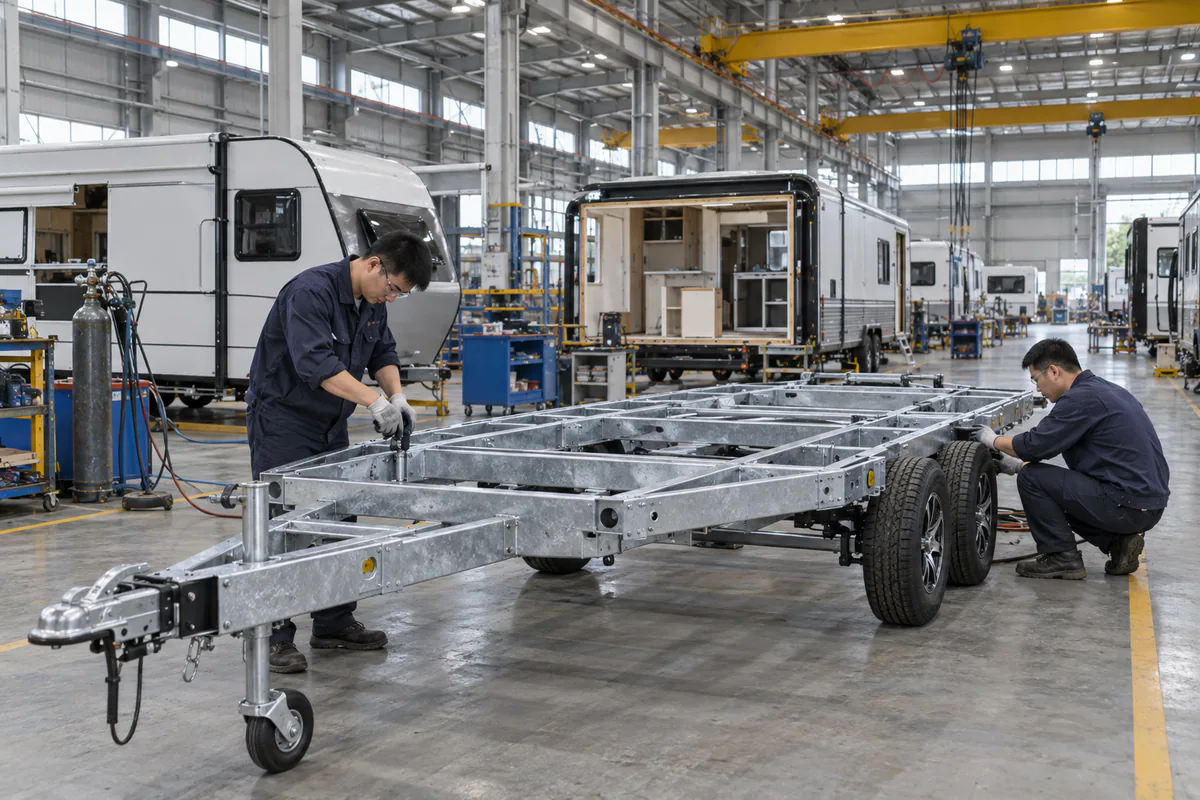
Sample approval should be a joint review of the agreed configuration, not just a visual inspection. Confirm the dimensions and interfaces that matter to your buyer, then review workmanship, functional systems, access panels, finish samples and the documents that will accompany shipment. Photograph open points and give every change a clear owner and due date.
Before final release, agree the shipment inspection scope. Many B2B buyers benefit from an agreed photo record, final checklist, packing confirmation and loading evidence. These records do not replace local regulatory advice or destination-market testing, but they make the handover more transparent.
Separate commercial choices from engineering choices
Many projects become difficult because commercial conversations and engineering decisions are blended together too early. A buyer may request a target price, a different exterior colour and an additional energy feature in the same message, yet each decision has a different effect on the finished product. Price positioning belongs in the commercial brief. Exterior direction can usually be handled through approved finish options. Energy, mass, ventilation and electrical interfaces may require engineering review.
Create an issue list that records the question, the proposed decision, the reason it matters, the owner, the approval status and the latest revision. This may feel formal for an early project, but it gives both teams one version of the truth. It also makes it easier to tell whether an OEM requirement is mature enough for a quotation or whether the project should begin as a controlled ODM configuration.
Ask the factory to distinguish three categories: standard platform content, selectable options and new engineering requests. The boundary is important. Standard content should be documented. Options should have clear compatibility rules. New requests should not be treated as confirmed until the manufacturer has reviewed their effect on materials, production sequence, testing and service access.
Plan prototype reviews around real buyer decisions
A prototype review should answer the questions that sales, service and operations teams cannot answer from a drawing. Does the layout work for the expected occupant profile? Are storage, bed conversion, access panels and routine controls understandable? Do the selected finishes tolerate the likely duty cycle? Can a dealer technician reach the items most likely to need routine attention?
For a private-label program, bring examples of your customer-facing material to the review: product positioning, competitor references, customer feedback, dealer comments and required accessory fitment. This keeps the conversation connected to the market rather than becoming a list of isolated component preferences. A factory team can advise on build feasibility, but the buyer should remain responsible for defining the customer promise it intends to make.
Use a review record that separates observations from approved changes. A comment such as “make it stronger” is not actionable until it identifies the part, the expected use condition and the evidence needed to approve the change. Clear language shortens the path from review to production release.
Control changes after sample approval
Changes are normal in complex products. The risk comes from changes that are made in chat messages, verbal calls or isolated drawings without being transferred to the controlling specification. After sample approval, any requested change should show its effect on cost, lead time, mass, compatibility, testing, documentation and shipment inspection. Not every change needs a long report, but every change needs a traceable decision.
This is especially important when an ODM project is being gradually customized. Small additions can interact: a larger battery may change charging hardware, cable routing, storage space or gross mass; a new exterior accessory may affect mounting points, sealing and packing. The best moment to discover these interactions is during engineering review—not on the finished unit.
For multi-market programs, create a separate configuration record for each region or sales channel. Do not rely on a single generic model name if the equipment, labels or installation preparation differ. This protects the product information used by sales, dealers and after-sales teams.
Ask for evidence that supports a transparent handover
Evidence should be proportional to the project. A buyer does not need a large file of generic photos; it needs records that help confirm the agreed configuration. Depending on the build, this can include approved drawings or option schedules, factory testing photographs, a final inspection checklist, system-operation evidence, packing details and shipment inspection photographs.
For new suppliers, agree the evidence list before production begins. It is easier to capture a useful photo at the correct production stage than to recreate it after panels are closed or a unit is packed. Keep the language factual. A photo can confirm that a component was fitted; it cannot by itself prove destination-market compliance or long-term performance.
When the product reaches your facility, use the same approved specification during receiving inspection. This connects the customer requirements defined at the start of the project with the shipment inspection completed at the end.
Conclusion: choose the route that reduces uncertainty
OEM and ODM are both viable ways to source a travel trailer. The better route is the one that makes your main risks visible early. If product differentiation, operating conditions or customer requirements are already defined, an OEM process can provide the control you need. If your team wants to validate a category with a proven base, ODM can offer a practical starting point.
In either case, success comes from the same disciplines: a clear brief, feasibility review, documented approvals, factory testing tied to the intended use, and a transparent shipment handover. The first conversation should focus on those controls—not simply on whether a supplier says it can customize.
Common mistakes to avoid
The first mistake is treating ODM as a cosmetic exercise. A colour, appliance or accessory change can affect mass, system compatibility, sealing, service access or production sequence. The second is treating OEM as an unlimited request for custom work without a stable brief. The third is approving a sample visually while leaving operational decisions unresolved.
A more reliable approach is to decide what makes the product commercially distinct, what must work in the target market and what can remain within the proven platform. Record the decision before it becomes a factory instruction. This helps both sides focus their time on changes that create real buyer value.
Use authoritative requirements as context
Quality-system and vehicle-regulation references can help a buyer frame questions, but they do not certify an individual project. ISO 9001 describes quality-management-system requirements, while destination-market obligations should always be confirmed with the relevant authorities and qualified advisors.
Frequently asked questions
Can an ODM platform still carry a private label?
Yes. A private label can be applied to an ODM program, but the buyer should document exactly which visual, equipment and documentation changes are approved. Branding does not automatically make a platform unique or market-ready.
Does OEM always require a completely new trailer?
No. OEM can begin from a proven architecture. The difference is that the buyer and manufacturer agree a more defined set of structural, system or application requirements and control changes against that brief.
What should be approved before a production deposit?
At minimum, confirm the target configuration, change-control method, sample or drawing approval path, quality checkpoints, inspection scope, documentation and commercial terms. Local compliance requirements should be verified separately for the destination market.