
 RVDwell OEM TRAVEL TRAILERS
How to Specify a Travel Trailer Solar and Battery System
A B2B guide to matching travel trailer solar, battery, charging and service requirements to real customer use.
A travel trailer solar and battery system should be specified from the customer load profile, desired autonomy, charging sources, service capability and safety requirements. Panel size or battery capacity alone does not describe whether a system fits the intended use.
Who this guide is for
This guide is for travel trailer buyers selecting onboard power packages for touring, rental or off-grid applications.
Start with appliances, charging needs, expected trip pattern and access to external power. Then choose a system that can be installed, protected, documented and serviced in the target market.
Build a realistic load profile
List the equipment that will actually draw power, when it will run and what the user expects while away from hookup power. Include lighting, refrigeration, pumps, ventilation, charging and any optional appliances. Separate essential loads from convenience loads.
This makes the conversation more useful than selecting a battery or panel based on a headline number.
Review charging as a complete system
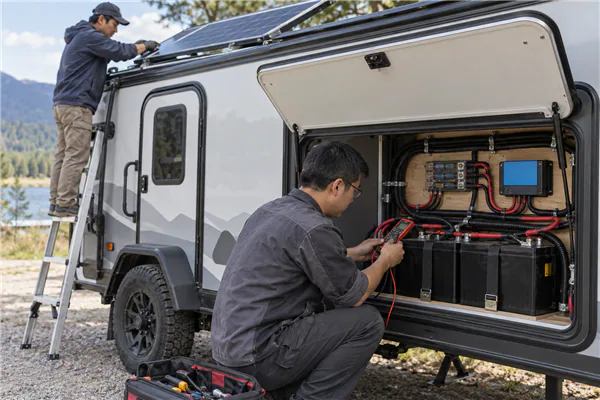
Solar is only one input. Consider external hookup charging, vehicle charging where applicable, protection, cable routing, controller location and battery access. The manufacturer should review these components as a compatible system within the trailer layout.
Ask how the system is labeled and what service information will be supplied to dealers or fleet technicians.
 RVDwell OEM TRAVEL TRAILERS
Need to compare a platform, custom requirement or factory process against your market brief?
Get a project checklist →Protect service access and user understanding
Power systems need clear instructions for normal use, storage, charging and fault escalation. Plan access to fuses, disconnects, controllers and battery compartments before interior fit-out is finalized. A technically capable system is less valuable if routine checks require major disassembly.
For rental use, simplify the customer-facing controls and make the handover routine repeatable.
Verify the installed package at handover
Factory testing should confirm the agreed installed components and basic operation under available test conditions. The shipment record should identify the approved power package and related documentation. Destination-market installation and compliance requirements remain a separate responsibility to verify.
Use early customer or dealer feedback to improve manuals and service stock rather than changing electrical details informally.
Buyer worksheet: questions to close before a quote
Use this short worksheet in a supplier meeting, a factory visit or a sample review. It is designed to turn customer requirements into records that engineering, production, quality and logistics teams can act on.
- Essential and convenience loads listed
- Solar, external charging and protection reviewed together
- Service access and labeling planned before fit-out
- Customer or rental handover kept simple
- Installed system identified in final documentation
For a new RVDwell project, this information can be reviewed alongside the factory capability, the custom-build process and the agreed shipment-inspection scope. The final requirement should always reflect the destination market and approved product configuration.
What evidence to request from the factory
Useful evidence is specific to the unit and stage: an approved configuration record, production-stage photographs where appropriate, factory testing results, a corrective-action log and a shipment inspection record. It should show how customer requirements moved from the brief into the delivered trailer.
Do not rely on a generic certificate or a finished-product photograph as the only proof. Ask which records apply to your model, who completes them and how a failed check is corrected before the unit advances.
Frequently asked questions
Is a larger battery always better?
Not necessarily. Battery choice should match loads, charging inputs, mass, space, cost and service capacity. A balanced system is more useful than an oversized component chosen in isolation.
Can solar replace hookup charging?
It depends on the load profile, weather, season and system design. Buyers should define the intended application rather than make a universal promise.
What should be tested before shipment?
Verify the approved components, visible installation quality, labeling and agreed basic functions under the factory test setup.
Reference sources
External requirements and market rules should be checked against the destination and final configuration. These authoritative starting points support the planning questions in this guide.